
Why Semiconductor Companies Need a Real Talent Acquisition Strategy (And How to Build One)
Over the past year I’ve had a lot of conversations with semiconductor companies across Europe.
From design houses, fabs, IP providers, to equipment manufacturers.
Many of them are busy hiring, sometimes aggressively, but only a small number actually have a real strategy behind it.
Most have a list of open roles.
Some hire when someone resigns.
Others wait until a project is already slipping before starting the recruitment process.
But none of that is a Talent Acquisition strategy.
That’s simply recruitment.
Talent Acquisition vs Recruitment
I know this can be a bit confusing, because people often use the words “Talent Acquisition” and “Recruitment” as if they mean the same thing. But they’re actually two very different things, and it’s important to understand the difference.
In semiconductors, that difference really matters.
One delayed hire can push back a tape-out or slow down a customer delivery, so how you approach hiring has a direct impact on the business.
Recruitment is reactive.
It starts when a problem appears.
For example, someone leaves your team and you need to replace them, or a new customer is going live in three months and you suddenly realise you don’t have the right skills available.Talent Acquisition is proactive.
It’s about planning ahead so those problems don’t appear in the first place.
A proper TA strategy connects hiring directly to what the business is trying to achieve.
And this kind of forward-looking approach is becoming more important every year, especially in the semiconductor industry.
Why?
Because hiring in Semiconductors will only become more difficult.
Europe is already feeling the pressure on semiconductor talent.
The European Chips Skills Academy estimates that by 2030, the region will be short more than 65,000 skilled professionals, even with the training programmes currently in place.
SEMI Europe has also warned the European Commission that talent availability has become one of the biggest obstacles to growth, making it just as critical as funding and manufacturing capacity in the long-term strategy.
That means the companies who continue hiring reactively will be the ones struggling the most.
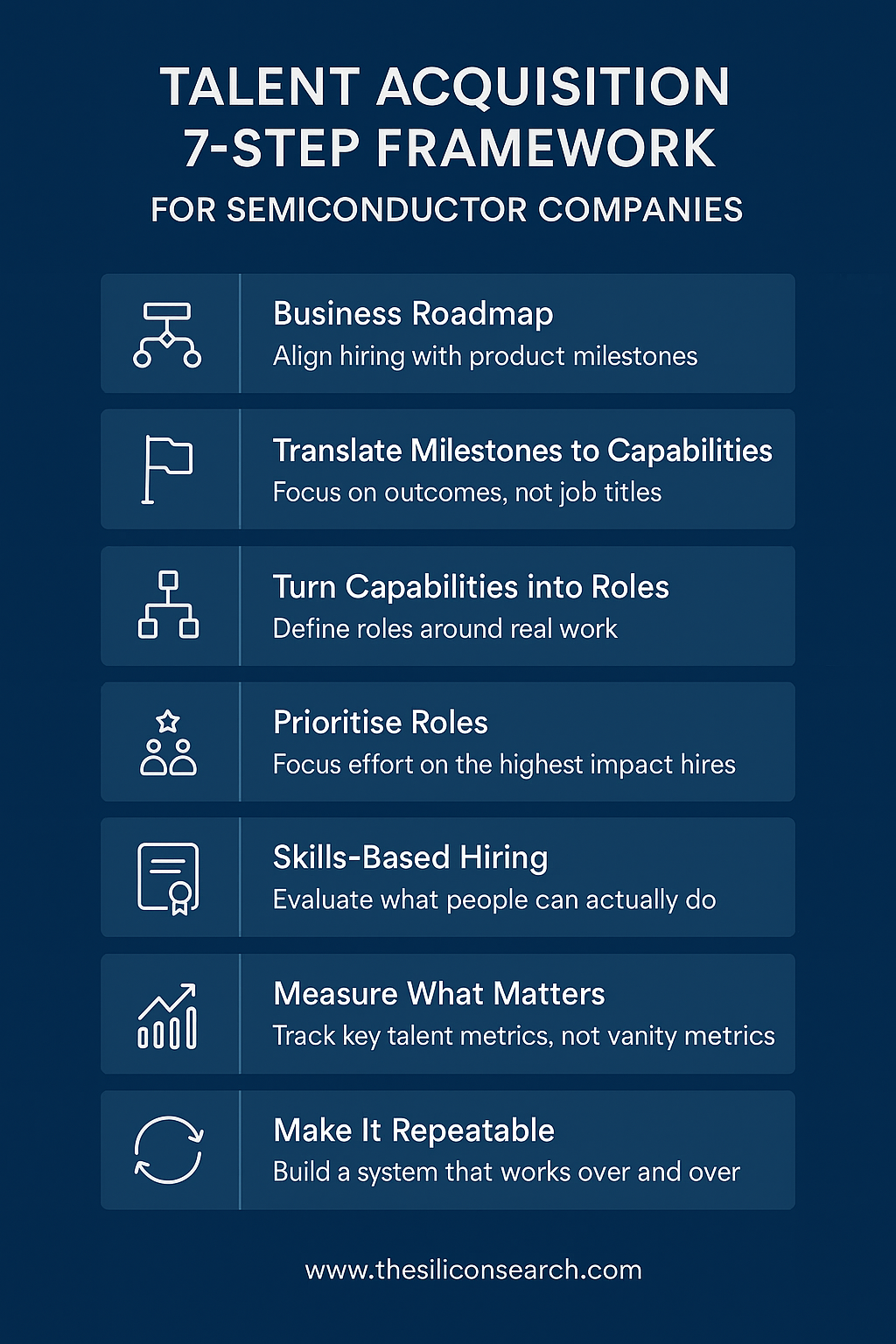
A Simple Framework
Below I have described the simple framework I shared during my talk about Talent Acquisition Strategies at a recent semiconductor conference.
It’s also the approach I use with clients and the one that consistently gives teams more predictability, better hires, and fewer last-minute emergencies.

1. Start With the Business Roadmap
“What are the big milestones you are looking to hit?”
When I work with semiconductor companies, the mistake I often see is this: hiring starts from a job description instead of the business plan.
But the business roadmap is where Talent Acquisition actually begins.
Take the next 12–24 months and write down the major milestones you must hit.
In semiconductors, these are usually concrete, non-negotiable events.
Examples of key milestones:
These are example milestones that should guide your hiring plan.
Each one is specific to your business and affects what skills you need, when you need them, and how quickly your teams must grow to keep the roadmap on track.
- Tape-outs
Customer delivery deadlines
New product launches
Moving from prototype to production
Entering new verticals (automotive, aerospace, industrial, consumer, etc.)
Scaling production capacity
Expanding validation or test capability
Opening a new design centre
Backbone of your Talent Acquisition Strategy
These milestones drive everything and are the backbone of your Talent Acquisition Strategy.
Some concrete examples:
Planning a tape-out in Q2 next year means your verification team needs to be fully productive months before that deadline.
Moving into the automotive market often requires capabilities you may not yet have in-house, such as functional safety, reliability, or AEC-Q100 expertise.
Expanding into a second product line will quickly increase the load on modelling, validation, firmware and applications teams, which may require new hires well before development ramps up.
What you will find is that when hiring is tied to these milestones, it becomes predictable.
When it isn’t, everything feels chaotic.
2. Translate Milestones Into Capabilities
Once the milestones are clear, the next question to ask yourself is:
“What capabilities do we need in the team to achieve these milestones?”
Instead of asking “what job titles do we need to hit our milestones”, I emphasise “capabilities”.
Because semiconductor projects are rarely defined by job titles.
They’re defined by outcomes.
Capabilities are a lot more useful than job titles because the focus on what actually needs top happen.
Examples of capability-based thinking:
Improve timing closure on critical RTL blocks
Bring up the first silicon board and validate interfaces
Develop firmware for the new power-management block
Prepare for ISO 26262 audits for automotive customers
Reduce test time by 20% on the new line
As you can see these are concrete, outcome-driven tasks that you can hire for, not just around.
A “Senior Analog Designer” could mean a hundred different things depending on topology, node, product, and responsibilities.
But “Design a low-power PLL for a 22nm sensor platform” is precise.
This step reveals gaps you didn’t know you had.
It also prevents unnecessary hiring, because sometimes you discover you don’t need a full role but a capability that might be delivered differently.
3. Turn Capabilities Into Actual Roles
Now that you know what outcomes the business needs, you can turn them into real positions.
I always walk clients through a simple exercise to turn capabilities into real roles.
We take each capability and ask a few practical questions to understand what the organisation actually needs:
1) Who can deliver this capability?
Do you need:
A senior engineer?
A mid-level designer who can grow?
A contractor with very specific experience?
A new graduate to take over less complex tasks?
In semiconductors, experience is unevenly distributed.
Some tasks need specialists; others don’t.
2) How experienced do they need to be?
This is where companies sometimes overhire I noticed.
You might think you need a Senior Firmware Engineer, but after mapping capabilities you might realise most tasks are board bring-up and driver maintenance.
Basically things a good mid-level engineer can handle.
If you’re entering automotive for the first time, you may realise you do need someone senior with experience navigating safety requirements.
3) When do you need them to be productive?
Not when they are hired. But when they are fully productive.
There’s a big difference.
In semiconductors, the value of a new hire isn’t in the contract being signed, but in when that person is fully contributing to the work that matters. And there could be months in between.
A verification engineer who joins a month before tape-out won’t make an impact in time.
The same goes for modelling, physical design, validation, or applications roles that have long onboarding curves.
Thinking in terms of “productive by when?” rather than “hired by when?” helps you plan roles earlier and avoid last-minute hiring pressure that can slow the whole roadmap down.
4) Where does this role sit?
Some companies uncover structural gaps during this exercise.
For example:
A reliability role might sit better under validation than design.
A test automation engineer might belong under software tools rather than manufacturing.
Once you go through these questions, the team structure becomes visible.
You can see who you need, when, and why.

4. Prioritise the Roles That Truly Move the Business
At this point you may discover you “need” 20 new roles.
But in reality, often only a handful will actually push the business forward.
Why is this step so important?
Everything will slow down
If you treat every open role as equally important, everything will slow down.
Because every vacancy competes for attention at the same time.
Hiring managers get stretched. Recruiters become overloaded.
And for every role you interview for, people need to step away from their actual work. In semiconductors, that usually means senior engineers reviewing CVs, running interviews, and giving feedback.
While they’re doing that, they’re not designing, verifying, or solving engineering problems. Multiply this across multiple roles, and the impact becomes very real.
The result is simple: everything slows down, and the roadmap starts to slip.
What to prioritise your vacancies on
I always advise to look at the following three factors to determine which roles are high priority.
A. Business Impact
Ask:
“If this role stays unfilled, what will happen to the business?”
In semiconductors the consequences are very real:
No verification engineer → tape-out slips
No physical design engineer → timing closure breaks down
No project manager → schedules drift
No reliability engineer → automotive customers lose confidence
No test engineer → production cycle times stay slow
B. Urgency
When does this person need to be productive?
A customer product launch in 4 months → urgent
Foundry submission deadline → urgent
A future product 18 months away → not urgent
Urgency protects delivery, not headcount.
C. Scarcity of available talent
Some semiconductor profiles in Europe are incredibly rare.
And this defines how we conduct our hiring process.
With scarce talent, we simply cannot afford:
Slow processes
Vague job descriptions
Unclear salary ranges
Overly complex interview loops
Scarcity shapes the entire hiring approach.
When you combine business impact, urgency, and scarcity, the high-impact roles become obvious.
And we have to treat these kind of vacancies different from the “non critical ones”.
High-impact roles should always get:
A faster interview process
Leadership involvement
Proactive candidate sourcing
And room for better salary offers (in case needed)
In short, high-impact roles are the ones that directly affect milestones.
And the people that we hire for these positions are the ones that will protect your business roadmap.
5. The Execution of the Process
At this point, we know which roles we need to hire for and which ones truly have priority.
The next step is execution.
In other words, how we actually run the hiring process.
This is where skills-based hiring becomes critical.
And from my experience, this is also where many organisations struggle to change old habits.
Skill-based Hiring
So what do we mean by skills-based hiring?
And how is it different from the way some companies still hire today?
At its core, skills-based hiring means moving away from CV-driven decisions. It’s about breaking the habit of judging candidates mainly on job titles, company names, or academic background.
Instead, the focus shifts to something much more relevant: what the person can actually do.
In practice, it looks like this:
Write job descriptions that describe real work
Instead of:
“7+ years of digital design experience”
Write:
“Ownership of timing closure for the sensor pipeline block.”
It becomes instantly clearer who is actually a fit.
Use interviews to test thinking, not history
Ask things like:
How would you approach debugging a failing interface on first silicon?
What are common STA bottlenecks and how do you address them?
How would you structure a bring-up plan for a new board?
You learn more in 10 minutes with this approach than in two hours of CV discussion.
Use a simple unified scoring system
A shared scoring system helps keep everyone aligned during interviews. Instead of each interviewer relying on personal impressions or memory, candidates are assessed against the same criteria that are directly linked to the skills and capabilities required for the role.
This makes feedback easier to compare across interviewers and avoids situations where opinions conflict without a clear reason.
As a result, hiring decisions are based on data and evidence rather than gut feeling.
Use Data in Your Hiring Process
Track the skills of top performers
Pay close attention to the people in your team who consistently perform well. Look at what makes them successful in your specific environment. What skills do they have? How do they approach problems? Where are they particularly strong?
When you analyse these top performers, patterns usually start to appear. You might notice that your best engineers share certain technical strengths, ways of thinking, or approaches to collaboration that don’t always show clearly on a CV.
Blueprint for future hiring
Once you see these trends, you can use them as a blueprint for future hiring. You screen and evaluate candidates on the same traits, because you already know these qualities work well inside your organisation. This helps you hire people who are more likely to succeed, not just on paper, but in the reality of your teams and projects.
Skills-based hiring makes decisions clearer and reduces mistakes.
It also speeds up the whole process because decisions become evidence-based.

6. Measure What Actually Matters
We can’t improve what we don’t measure. We all know this and this also counts for our talent acquisition strategy.
But there are many things you can measure.
Some companies track metrics like “time to hire” or “number of applicants”, but these are rarely useful.
What matters is whether your hiring supports the business.
So I always recommend to measure the following:
Quality of hire
This measures whether a new hire is actually performing well in the role and delivering what the business expected after they’ve had enough time to fully settle in.
You can only measure this after 9-12 months
You can measure this concretely:
Did they help hit tape-out?
Did they close verification or validation gaps?
Did yield improve?
Did customer escalations drop?
Critical roles filled on time
Track whether crucial roles were filled in time for.
As described earlier, if these positions are not filled in time, they will directly impact the business.
Offer acceptance rate
If strong candidates consistently decline your offers, something is off:
Role unclear
Process too slow
Compensation misaligned
Poor candidate experience
Internal mobility
I personally really like this one.
Internal mobility is important because it allows businesses to fill roles by developing and moving existing employees instead of always hiring externally.
It reduces hiring pressure, keeps valuable knowledge in the company, and gives people clear growth opportunities.
Over time, this also helps your employer brand grow naturally, because employees see that careers can progress inside the organisation.
7. Make the Hiring Process a Repeatable System
A Talent Acquisition strategy only works long-term if it becomes a repeatable, reusable system.
Something that continues functioning even when workloads spike or key people are unavailable.
This is where many semiconductor companies struggle, because hiring knowledge often lives in informal conversations rather than in a structured system.
So what can we do here?
Create a simple, reusable hiring playbook
Not a long HR manual.
Just a short, clear internal guide that covers:
How to translate milestones into capabilities
How to turn capabilities into roles
What “priority roles” mean in your company
Interview steps for different role types
Who makes decisions and when
The scoring system
Expected timelines for candidate movement
This consistency saves enormous time and reduces friction.
Review the roadmap every quarter
Semiconductor plans change often. Customer specs change, foundry schedules move, product priorities evolve.
A quarterly review helps you:
Update hiring priorities
Identify capability gaps early
Avoid last-minute hiring emergencies
Keep engineering and HR aligned
Track performance and improve every cycle
You can ask:
Did key hires arrive in time for certain key milestones?
Where did delays occur?
Which roles took longest to fill, and why?
Did slow decisions cost us good candidates?
This creates a feedback loop rather than hoping things improve.
Make capability planning part of normal engineering habits
In the strongest semiconductor teams, capability planning isn’t something that only happens when a role becomes vacant. It’s part of everyday engineering thinking.
Engineers and managers regularly ask themselves what skills the team will need next, based on upcoming design phases, new nodes, customer requirements, or market moves. The same way teams plan tape-outs, releases, or risk mitigation, they also plan future capabilities.
This makes it normal to have conversations like:
“We’ll need another STA engineer before the next node.”
“If we move into automotive, we’ll need functional safety experience.”
“We should start physical design hiring earlier this time.”
When capability planning becomes a habit, hiring stops being reactive.
Gaps are identified earlier, priorities are clearer, and teams avoid last-minute pressure. Over time, this creates a much more predictable and stable way of building semiconductor teams.
Why this matters
A repeatable hiring system protects you from:
Dependency on individual managers
Rushed decisions
Inconsistent interviews
Stressful last-minute hiring
Project delays caused by missing expertise
It creates something semiconductor companies desperately need: predictability.

Bringing It All Together
Hiring is not an HR activity.
It’s a business strategy.
And in semiconductors, where a single missing engineer can delay a product milestone, Talent Acquisition is not a support function.
It’s a growth engine.
And when hiring is aligned with your business roadmap, I promise you that:
You hire faster
You hire better
People stay longer
Your employer brand grows naturally
And your roadmap becomes predictable
The companies that start building a proper Talent Acquisition strategy now will be the ones who stay competitive in a market where skills are becoming scarcer every year.